
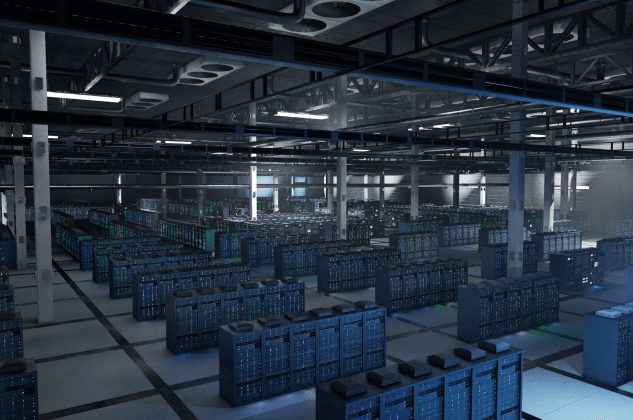
Artificial Intelligence is transforming industries worldwide, from healthcare and finance to manufacturing and smart cities. Behind every AI-powered application lies a powerful digital backbone — hyperscale data centers. These facilities, often called “Gigawatt AI Factories,” provide the massive computing power needed to process AI workloads, train machine learning models, and support cloud-based services.
As the demand for AI infrastructure grows rapidly, companies are investing in advanced hyperscale facilities capable of handling enormous data volumes with speed, scalability, and efficiency. Organizations such as Larsen & Toubro-Vyoma are contributing to the advancement of digital infrastructure solutions that support the future of AI-driven ecosystems.
For advanced digital infrastructure solutions, visit L&T-Vyoma
The Economics of Scale: Why Traditional Infrastructure Fails the GenAI Test
As organizations accelerate their adoption of Artificial Intelligence (AI), machine learning, and data-intensive applications, traditional on-premises infrastructure is increasingly unable to meet growing computational demands efficiently. Scaling legacy data center environments often results in higher capital expenditure (CapEx), increased operational complexity, and limited flexibility to support rapidly evolving AI workloads.
Hyperscale data centers address these challenges by delivering a highly scalable, cost-efficient infrastructure model capable of supporting massive computing requirements while optimizing resource utilization. Designed to accommodate thousands of servers, storage systems, and networking components, hyperscale environments enable organizations to scale capacity on demand without the limitations associated with conventional infrastructure investments.
Key Business Benefits of Hyperscale Infrastructure
- Lower Total Cost of Ownership (TCO) through optimized resource utilization and economies of scale.
- Faster AI and GenAI Deployment with access to high-density computing environments designed for intensive workloads.
- Improved Scalability to support evolving business requirements without significant infrastructure redesign.
- Enhanced Operational Efficiency through automation, centralized management, and optimized energy consumption.
- Reduced Infrastructure Risk by leveraging resilient, high-availability architectures built for mission-critical applications.
As AI adoption continues to reshape enterprise technology strategies, hyperscale infrastructure has become a critical enabler of innovation, allowing organizations to balance performance, scalability, and cost while supporting next-generation digital services.
Why AI Needs Gigawatt-Level Infrastructure
AI applications process enormous datasets and perform trillions of calculations every second. Training advanced AI models such as generative AI platforms and predictive analytics systems demands exceptional computational capabilities.
AI infrastructure must support:
- Large-scale data processing
- High-density GPU clusters
- Continuous uptime
- Ultra-fast networking
- Massive storage requirements
- Real-time inference processing
This is why hyperscale data centers are often referred to as Gigawatt AI Factories. These facilities consume significant power while delivering the computational capacity required for next-generation AI technologies.
L&T-Vyoma recognizes the growing need for scalable and energy-efficient infrastructure to support the expanding AI ecosystem.
GPU Infrastructure and the Race to AI Value: Accelerating Time-to-Market Through Hyperscale Partnerships
AI success depends on rapidly deploying the right infrastructure. Modern AI workloads require high-density compute powered by the latest NVIDIA Blackwell and Hopper GPUs, high-speed networking through NVLink and InfiniBand, and a robust software stack including Kubernetes and MLOps for efficient model deployment and management.
By partnering with a hyperscale AI data center provider, enterprises can access cutting-edge AI infrastructure without lengthy build cycles, accelerating innovation and reducing time-to-market.
How GPU-Powered Hyperscale Infrastructure Delivers Faster Business Outcomes
Reduced Time-to-Value
Organizations can deploy and scale AI initiatives immediately rather than spending 2–3 years planning, building, and commissioning specialized AI infrastructure.
Accelerated AI Model Development
High-performance GPU clusters dramatically reduce training times, enabling faster experimentation, model refinement, and deployment.
Scalable Growth Without Infrastructure Constraints
Businesses can rapidly expand AI workloads as demand increases without making large upfront investments in additional facilities or power infrastructure.
Real-Time Intelligence at Enterprise Scale
Advanced GPU environments support latency-sensitive applications such as predictive analytics, cybersecurity, autonomous systems, and financial modeling.
Optimized Capital Allocation
By leveraging hyperscale infrastructure, enterprises can focus investments on innovation and business growth instead of managing complex infrastructure upgrades and operational overhead.
As AI becomes a strategic business driver, access to scalable GPU infrastructure is increasingly a competitive advantage. Hyperscale data center partnerships help organizations accelerate innovation, reduce deployment timelines, and achieve faster returns on AI investments while avoiding the challenges of building AI-ready infrastructure from the ground up.
Securing AI Infrastructure: Protecting Enterprise Data and Compliance at Scale
As AI adoption grows, CIOs and CTOs must balance innovation with security, compliance, and data governance. AI workloads often involve sensitive business data, proprietary models, and critical intellectual property, making robust infrastructure security essential.
Modern hyperscale AI data centers go beyond physical security by offering:
- Multi-tenant data isolation to ensure secure separation of customer environments.
- Identity-based access controls and continuous authentication to ensure only authorized users and systems can access critical resources.
- Protection of proprietary AI models and training data during large-scale LLM development.
- Support for regulatory compliance including GDPR, HIPAA, and data residency requirements.
- Real-time monitoring and risk management to strengthen security and governance.
By combining scalable compute infrastructure with enterprise-grade security and compliance frameworks, hyperscale data centers enable organizations to accelerate AI initiatives while protecting sensitive data and corporate intellectual property.
Sustainability as a Strategic Advantage for Enterprise AI
As AI workloads grow, organizations are under increasing pressure to meet both performance and ESG objectives. Modern hyperscale data centers help enterprises reduce environmental impact while supporting high-performance AI operations.
Key sustainability initiatives include:
-
Target PUE below 1.2 to maximize energy efficiency and minimize power wastage.
-
Optimized Water Usage Effectiveness (WUE) through advanced cooling technologies and responsible resource management.
-
Renewable energy integration to reduce dependence on traditional power sources and lower carbon footprints.
-
AI-driven power management that continuously optimizes energy consumption across infrastructure.
-
Reduced Scope 3 emissions, helping enterprises strengthen sustainability reporting and achieve corporate ESG goals.
By leveraging energy-efficient hyperscale infrastructure, organizations can accelerate AI innovation while improving operational efficiency, reducing environmental impact, and advancing long-term sustainability commitments.
The Future of AI Infrastructure: Building for the Gigawatt Era
As AI and GenAI workloads continue to grow, enterprises require infrastructure that delivers higher power density, advanced cooling, ultra-low latency networking, and seamless scalability. Traditional data centers are increasingly challenged to support these next-generation requirements.
|
Metric |
Traditional Data Center |
AI-Ready Hyperscale Data Center |
|
Power Density |
5–15 kW per rack |
40–100+ kW per rack |
|
Cooling |
Air Cooling |
Advanced Liquid Cooling |
|
Scalability |
Limited |
Modular & Rapid |
|
AI Readiness |
Moderate |
Optimized for AI & LLMs |
Key Takeaway for Leadership
Hyperscale AI infrastructure enables organizations to accelerate AI adoption, reduce operational complexity, and scale efficiently for future growth. By investing in AI-ready facilities, enterprises can achieve faster innovation and long-term business resilience.
Conclusion
Hyperscale data centers have become the foundation of modern AI innovation. These Gigawatt AI Factories provide the computational power, networking capabilities, and energy-efficient infrastructure required to support AI workloads, cloud computing, and high-performance digital ecosystems.
From GPU-powered computing and advanced cooling systems to sustainable energy management and edge computing integration, hyperscale infrastructure is shaping the future of digital transformation.
As AI adoption continues to expand across industries, scalable and intelligent infrastructure solutions from organizations like Larsen & Toubro-Vyoma will play a vital role in enabling the next generation of digital growth.
To learn more about advanced digital infrastructure solutions, visit Larsen & Toubro-Vyoma