
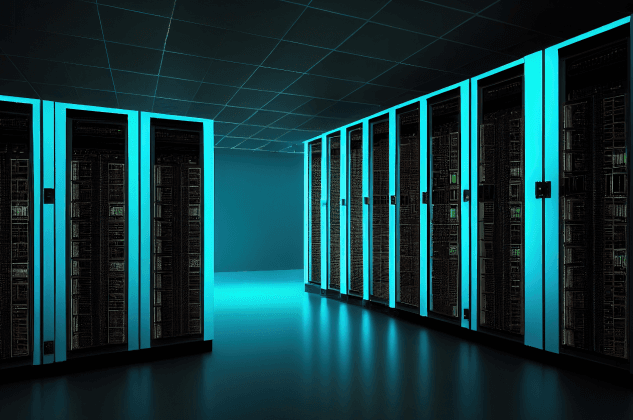
“AI-ready” may be the most freely awarded label in infrastructure right now. Every facility with spare floor space and a marketing budget claims it, and from a brochure the claims look identical. At L&T Vyoma we build these facilities, so we’ll tell you the actual difference, and it isn’t a sticker or a spec sheet. A traditional data center was designed for servers, then asked to host GPUs. An AI-ready data center was designed backwards from the GPU: the power, the floor, the cooling and the network all derived from what a dense accelerator cluster demands. Between those two starting points sits a wall that no retrofit budget reliably climbs. This piece gives you five tests to find out which side of the wall a facility is really on.
Start with the Rack and Work Outwards
The gap begins at the rack and compounds from there. A conventional enterprise rack draws 5–15 kW and is cooled by moving air. A modern AI rack is a different machine: a single NVIDIA Blackwell GPU can draw around 1,000 W, and a rack-scale GB200 NVL72 pulls roughly 120 kW in one cabinet — about the load of an entire row in a legacy hall, concentrated in a single footprint. Everything else in the building has to answer to that number. The busbars feeding the rack, the slab holding its weight, the loop pulling its heat out, the fabric carrying its traffic. Get any one of them wrong and the cluster throttles, whatever the brochure said.
The Five Tests of a Genuinely AI-Ready Facility
When you evaluate a facility, ours included, put these five questions to it and ask for evidence in writing:
- Power: what density is engineered, not aspired to? Ask what the hall delivers per rack today, at full population. AI-ready means 100 kW+ per rack with headroom as accelerators densify, and the difference between designed-for and hoped-for shows up the first time every rack is loaded at once.
- Cooling: does liquid reach the chip? At AI densities, air is not an option; “chilled air, but colder” is a retrofit tell. The real answers are Direct Liquid Cooling to the cold plate, Rear Door Heat Exchangers for mixed floors, and immersion for the most aggressive nodes.
- Structure: can the slab take a tonne per rack? Fully populated GPU racks weigh well over a tonne. Our halls are built for 1,850 kg/sqm in Chennai and up to 2,500 kg/sqm at Mahape. A facility that can’t quote its floor-loading figure hasn’t done this math.
- Network: is the fabric east-west? Distributed training is thousands of GPUs in constant conversation. That needs a low-latency, high-bandwidth internal fabric, not the internet-facing, north-south design a web-era facility optimised for.
- Operations: is efficiency measured in production? Industry-average PUE has sat at about 1.56 for years (Uptime Institute). A design-sheet number is easy; what matters is real-time BMS and DCIM instrumentation holding a low PUE while the load shifts hour to hour.
The Retrofit Wall
Why not upgrade a traditional facility? Because three of the five tests live in the structure. You can add cooling capacity; you cannot easily quadruple a slab’s load rating, re-run power distribution designed for a tenth of the density, or reshape a building’s network topology without gutting it. This is the quiet reason “AI-ready” retrofits so often stall well short of true AI densities: the building itself votes last, and it votes no. It is also why we design from the foundation drawings — as an engineering-and-construction company, L&T puts the density, the loading and the cooling topology into the concrete, where they can’t be value-engineered out later.
Density Is an Economics Problem, Not a Bragging Right
Why do these tests matter commercially? Because rack density can sound like an engineering vanity metric. It isn’t. A GPU cluster that throttles under thermal load is a cluster you paid for twice: once in hardware or service fees, and again in the training hours it silently loses at 2 a.m. when utilisation should be flat-out. Density done properly also compounds the other way. A hall that holds 100 kW per rack in a fraction of the footprint needs less land, shorter cable runs and fewer losses between the substation and the silicon, and a facility instrumented to hold its PUE low in live operation puts more of every purchased megawatt into actual compute. For the enterprise consuming the cluster, all of that arrives as one number: cost per training run, or per million tokens served. The five tests are how you predict that number before you sign.
What Sits on Top
The facility is the qualifier; the compute is the point. Our Tier III campuses in Mumbai and Chennai carry the AI Factory — Blackwell, Hopper and RTX fleets delivered as a service — alongside colocation for enterprises bringing their own GPU clusters into halls that can actually feed and cool them. Capacity beyond today’s campuses is mapped across upcoming sites, designed to the same rule: backwards from the GPU.
The Difference, Test by Test
|
The Test |
Traditional Data Center |
AI-Ready (L&T Vyoma) |
|
Power per rack |
5–15 kW, designed for servers |
100 kW+ engineered from day one |
|
Cooling topology |
Ambient air, room-level |
Liquid to the chip: DLC, RDHx, immersion |
|
Floor loading |
Standard office-grade slabs |
1,850–2,500 kg/sqm for tonne-plus racks |
|
Network fabric |
North-south, internet-facing |
East-west, built for GPU-to-GPU traffic |
|
Instrumentation |
Periodic manual checks |
Real-time BMS + DCIM tuning PUE in operation |
|
Upgrade path |
Retrofit hits structural walls |
Designed backwards from the GPU |
Ask the Five Questions
The label on the door tells you nothing; the answers to the five tests tell you everything. Put them to any facility on your shortlist, and put them to us — talk to our team or start with the AI Factory and see how a building designed backwards from the GPU answers.